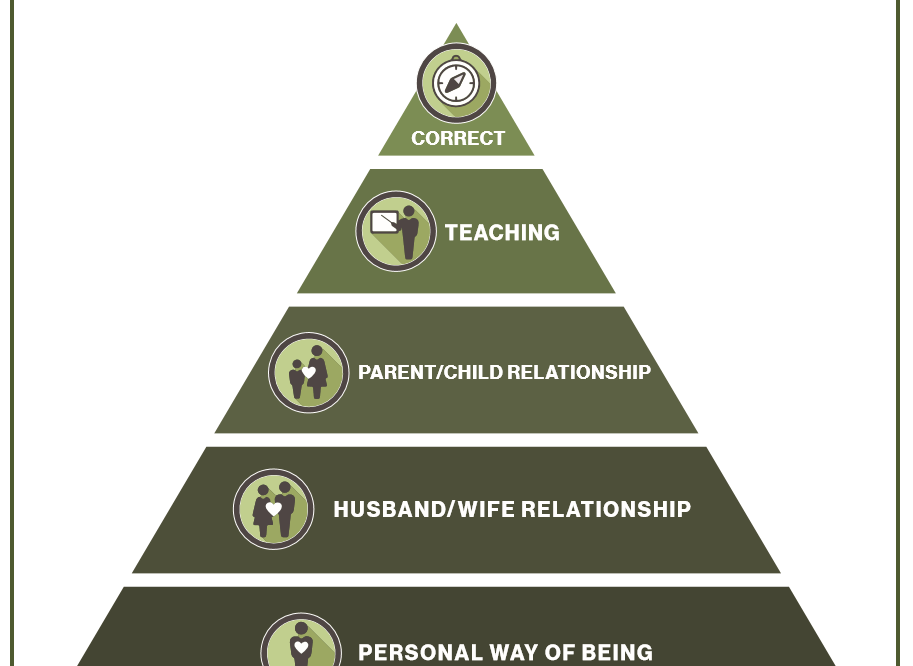
Correcting and disciplining our children are things that can be very challenging, even for the most seasoned parents. What if I were to tell you that there is a way to effectively correct your children, without harming your relationship, or causing contention? Does it sound too good to be true? It is not. There are several ways that we can effectively discipline and correct our children without putting them down, belittling them, or making them feel bad about themselves. We can correct behaviors that aren’t okay, and we can effectively discipline our children when they have done something bad, or something we consider unacceptable.
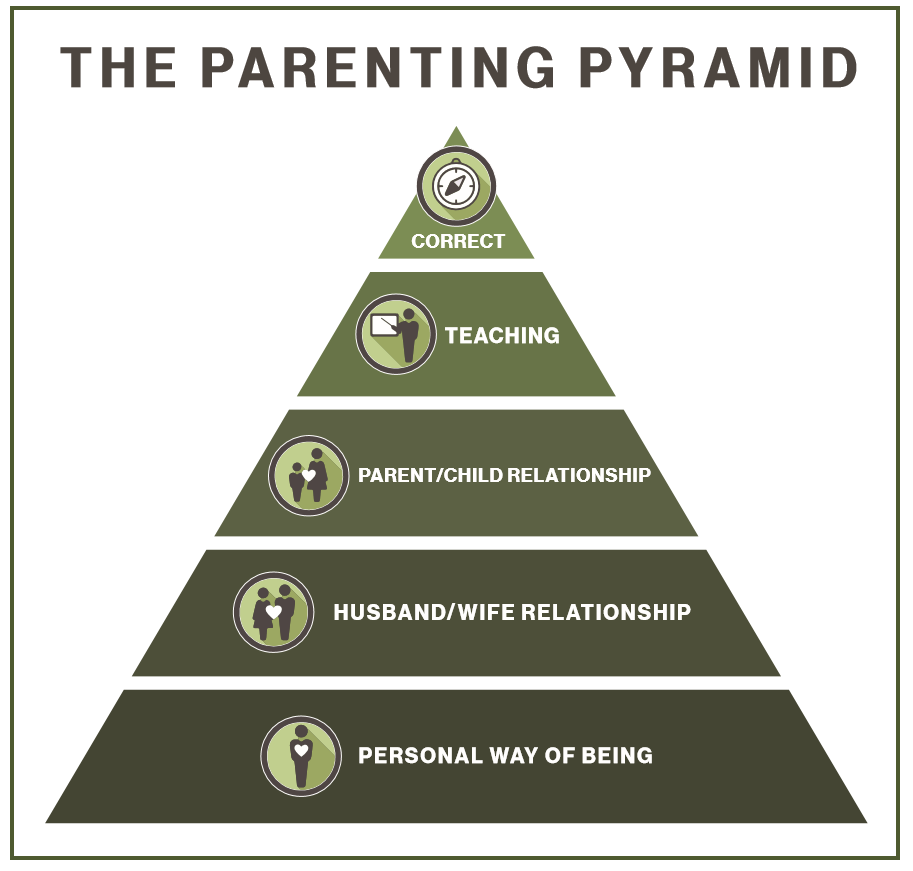
I want to introduce to you something called ‘The Parenting Pyramid.’ The Parenting Pyramid is a step by step way to correct your children when they do things we don’t want them to do. You see, before we can correct our children, we have to be able to teach them. In order to teach them, there are a lot of things we need to take into consideration. For starters, we need to take into account their age and maturity. If we try to teach our kids too much too soon, they won’t understand the lesson. For example, if I wanted to teach my child about something complex like intimacy, I would first look at how old they are. Say they are four. I wouldn’t start giving a whole lecture on sex and relationships, I would start with learning about taking care of our bodies, and teaching them how important they are as an individual. As they get older, my husband and I would teach a little bit more, based on age and maturity. Any information we give our children needs to be understandable to them. We need to make sure they are ready to learn. How do we know when they are ready? One way to determine if our kids are ready, is if they are asking questions. Questions “allow children to get information they need to move their knowledge structures closer to adult-like states” (Monogr, 2007).

So here is a great question I want you to think about before moving on to the next paragraph: When we teach our children, how can we get them to not only ask questions, but also listen to the answers and council we give them?
Did you think about it? What if I told you one of the best ways to teach your children, and make them comfortable enough to ask you questions, is to form a strong relationship with them? Who would you want to learn from? Someone you trust and love? Or someone who scares you, or who you feel you don’t know? Children will be more comfortable learning from us as their parents, if we work on the relationship we have with them. They will be more willing to listen to the things we teach them, and in teaching them we will be able to more effectively correct them (Arbinger p. 4).
It is not just about love though, our children need to like us in order to be open to learning from us. Think back to high school. Was there ever one teacher that you really liked, and The way they taught you made perfect sense? You seemed to understand and absorb everything they taught you. Why is that? Is it because they were just a good teacher? Or was it because they had a good, appropriate relationship with their students, you liked them and were more willing to listen to what they had to say? For example, I had a math teacher in high school who, for whatever reason, got through to me. Let me be clear, I am horrible at math. I struggled for so long, until I had a certain teacher. Not only did I like him as a person, but because of that I was more willing to pay attention to the things he taught. In comparison I had a different math teacher the next year who I really struggled with, and I nearly failed math that year. Both of these teachers taught, but I only liked one of them. I wasn’t the only one who felt that way in my grade either. It is important to have a good relationship with our children. Not only is it healthy, but it will build a trust between the two of you that will enable you to teach them the principles and life lessons that you want them to learn without using harshness or punishment.
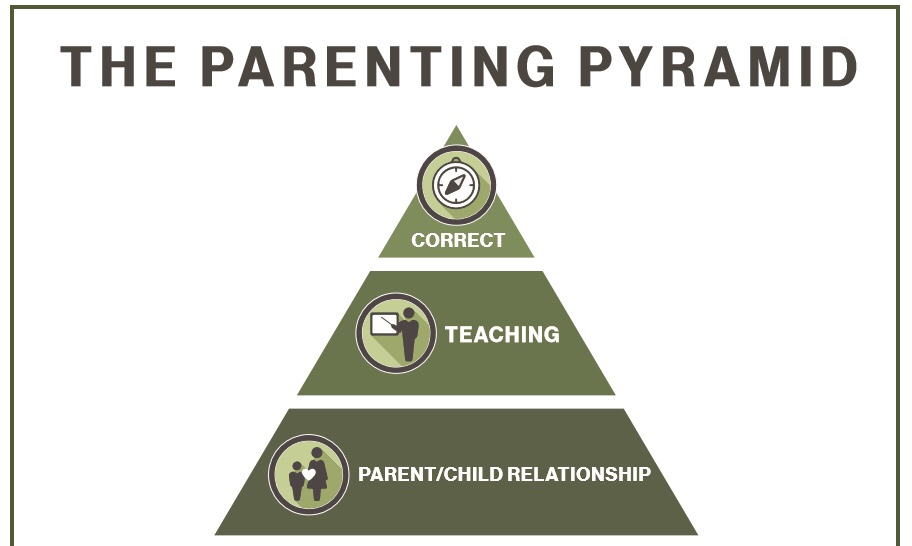
Alright, I have another question for you! This one may be a little more tricky. How can we ensure that our relationship with our child is strong?
What if I told you that the quality of the relationship you have with your children is dependent on the quality of the relationship you have with your spouse? Sometimes as parents we tend to compartmentalize. We look at our relationship with our spouse and our relationship with our children as two different things. So isn’t it interesting that the quality of the relationship we have with our spouse can affect the relationship we have with our children. “If parents have difficulties with each other, one way or another children will get sucked into them” (Arbringer p. 5). Parents may compete for their child’s affection, putting the child in a very hard situation. Arbringer says “The marital relationship is the central relationship in the family; in significant ways it colors all the others. This is why someone once said that ‘a woman happy with her husband is better for her children than a hundred books on child welfare.’ And it was why another was able to tell fathers ‘The most important thing you will ever do for your children is to love their mother.'” (p. 5)
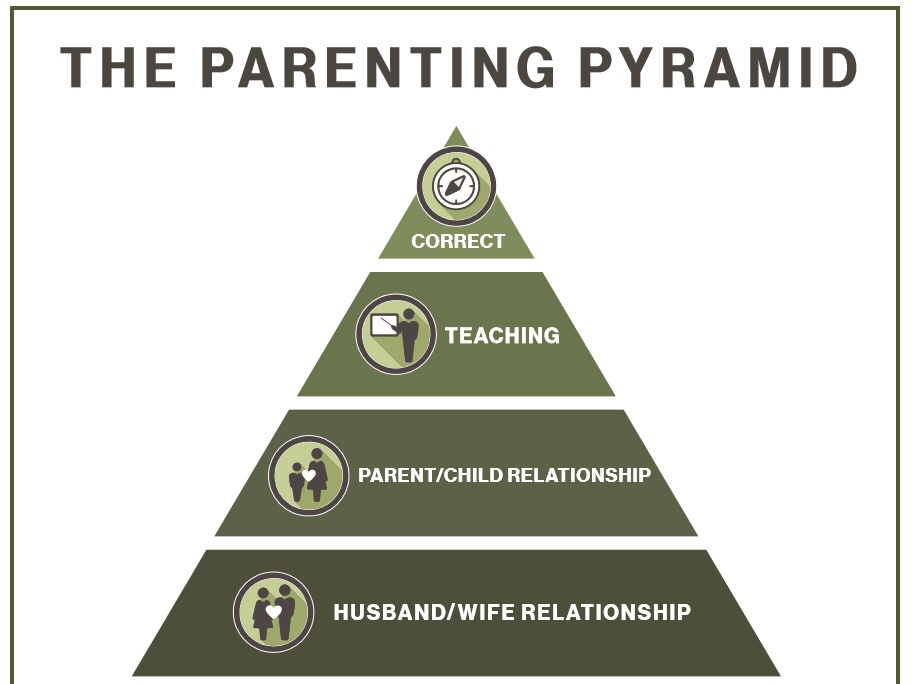
Question: Who are you? What attitudes and feelings are your bringing into your relationship with your spouse and children?
There is one final thing that will have an affect on all of the above things that we have talked about, and that is your general attitude towards life, or your “way of being.” Who are you as a person? Who we are is reflected in how we talk to and relate to those around us. Our way of being is who we are and how we talk to others. It reflects entirely on our relationship with our spouse. Are you appreciative? Selfless? Loving? Kind? The relationship between you and your spouse is entirely dependent on what you bring to it, and who you are. So who do you want to be? We are made to change, grow, and evolve. We aren’t set in stone, we are malleable. Is your relationship with your family strained? Instead of blaming them, or outside circumstances, take a look at yourself, and ask yourself, “What am I bringing to the relationship?”
Now that we have discussed basic correction, I want to touch on punishment. Punishment is a tricky subject. As parents, we will always run into some old person who says something to the effect of “When I was young, I was spanked with a wooden spoon, and it taught me respect.” Now, what if I told you that extensive studies, and science prove that old person wrong? (I say old person because as a society we are moving away from corporal punishment.) So let’s dive in and talk about spanking and corporal punishment.
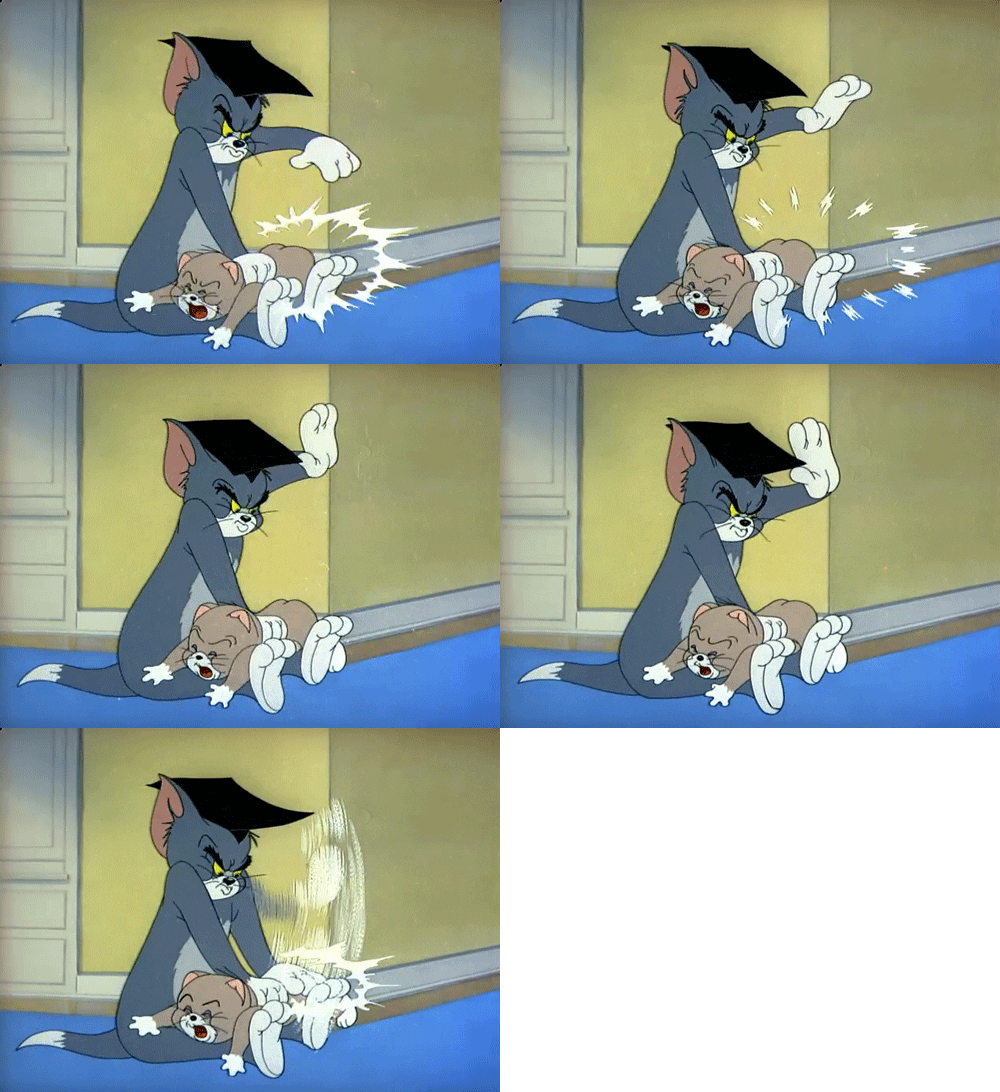
If you read the post before this one, you learned about authoritarian parenting. Corporal punishment is commonly associated with authoritarian parenting (Lauer and Lauer, p. 277). Corporal punishment isn’t just spanking though. It could be slapping, striking, shaking, beating with an object, and physical abuse (Lauer and Lauer, p. 277). Corporal punishment has the potential to have harmful effects on children. For example: Several studies show that corporal punishment can lead to different behavioral problems like depression, aggression, and addictive behavior (Afifi et al. 2012; Gromoske and Maguire-Jack 2012; Altschul, Lee, and Gershoff, 2016). Another interesting Study was done and cited by Lauer and Lauer (p. 277) about the effects that more sever forms of corporal punishment had on children after they had grown up and gone off to college. It said that “College students who had experienced the highest level of physical punishment while growing up reported more negative relationships with their parents, more family worries, more depressive symptoms, and more negative social relationships (Leary et al. 2007).”
So, how can we effectively discipline our children without hurting them physically or emotionally, and without harming our relationship with them? Author of the book “10 Basic Principles of Good Parenting” Dr. Laurence Steinberg says “No matter how angry you are. No matter what your child has done. No matter how frustrated, annoyed, desperate or fed up you are. In the long run, when you use physical punishment, you are creating more problems than you are solving” (Steinbert, p. 149). He points out that there are always exceptions to this rule, and even to the studies that have been published, but we need to remember that these exceptions don’t disprove the rule. Lauer and Lauer say that “parents should make every effort to use other ways to discipline children” (p. 279).
A good way to discipline our children effectively without hurting them would be to use authoritative parenting, as referenced in my last post. In his book, Steinberg gave an example on how to effectively teach and discipline our children:
- Identify the specific act or behavior that was wrong
- State the impact that the misbehavior had or could have had on others.
- Suggest alternatives to the behaviors that were unacceptable.
- Be clear about what the punishment is for the undesirable behavior.
- Make a clear statement of what you expect your child to do next time.
Here is an example of how the above could go:
Identification: “I have told you so many times not to hit people. I have asked you to please use your words instead of hitting when you are angry.
Impact: Hitting your sister is not nice. You could have really hurt her.
Alternative: People are not for hitting. If you really feel like you need to hit something, try hitting something else. Hit something soft like a pillow, or throw a tennis ball against an empty wall.
Punishment: You are going to sit in time out for three minutes and think about what I have told you. When you are done, you will go apologize to your sister.
Expectation: Next time you are angry I expect you to act differently. You will not hit again.
Now, is the above scenario going to work every time? Maybe not, but it is worth a shot to try it. Talking is better than physical punishment. When we talk things out with our children we can explain to them why the behavior is not okay. Right now, my child is in the “why” phase. He wants to know why we do things, why we don’t, and why things are the way they are. Rather than getting annoyed I answer those why’s to the best of my knowledge, until I don’t have an answer. We need to correct and discipline our children in a way that is both effective, and that won’t harm the parent/child relationship.
As parents we just want what is best for our children. We want them to be happy, and healthy. We also want them to be good people when they grow up. In order to help them be good people, we owe it to them to be the best parents that we can be, and to respond with love, and firm expectations when they act out. We also owe it to them to have a loving and strong relationship with them, so that they always have someone in their corner that they can turn to for help and guidance.
Cited Sources
Afifi, T. D., et al. 2012. “Physical Punishment and Mental Disorders.” Pediatrics 130:184–92.
Altschul, I., S. J. Lee, and E. T. Gershoff. 2016. “Hugs, Not Hits: Warmth and Spanking as Predictors of Child Social Competence.” Journal of Marriage and Family 78:695–714.
Arbringer Company. (1998). The Parenting Pyramid. The Arbringer Company. Retrieved from https://content.byui.edu/file/91e7c911-20c5-4b9f-b8fc-9e4b1b37b6fc/1/Parenting_Pyramid_article.pdf
Gromoske, A. N., and K. Maguire-Jack. 2012. “Transactional and Cascading Relations Between Early Spanking and Children’s Social-Emotional Development.” Journal of Marriage and Family 74:1054–68.
Lauer, R. H., & Lauer, J. C. (2007). Marriage and family: The Quest for Intimacy (9th ed.). Boston: McGraw-Hill.
Leary, C. E., M. L. Kelley, J. Morrow, and P. J. Mikulka. 2007. “Parental Use of Physical Punishment as Related to Family Environment, Psychological Well-Being, and Personality in Undergraduates.” Journal of Family Violence 23:1–7.
Steinberg, L. D. (2005). In 10 Basic Principles of Good Parenting. New York: Simon & Schuster Paperbacks.
 Parenting Perspectives